A Whimsical "Sin of Sorting": What If You Use a Random Comparator for Sorting?
What happens if I use a random function as a comparator when sorting?
- · A Whimsical Thought
- · Initial Guesses
- · Behavior by Language
- · JavaScript (Node.js v24.14.0 / Bun.js 1.3.14 / Deno.js 2.9.2)
- · Python (Python 3.14.3)
- · Go (go 1.26.2)
- · C++ (clang 22.1.8)
- · C# (.NET 10.0.301)
- · Java (JDK 26.0.1)
- · Rust (rustc 1.97.0)
- · Rust: But Is That Really the Whole Story?
- · Summary
A Whimsical Thought
Tonight, perhaps out of sheer boredom, a thought struck me: What if I use a random function as a comparator when sorting?
Normally, the comparator passed to sort should return a boolean indicating a < b to decide which element comes first. But what if I make it return randomly? How would the sorting algorithm behave?
And how would different languages handle this kind of "violation" or undefined behavior? Would they produce a shuffled result, or would they throw an error?
Thus, this repository was born: sorting-sinsopen_in_new
The languages tested in this project are:
- JavaScript (Node.js & Bun.js & Deno)
- Python
- Go
- C++
- C#
- Java
- Rust (latest & v1.80.0)
I wrote the code for JavaScript, Python, and Go myself; the other languages were generated with AI assistance.
Initial Guesses
Initially, I thought other languages might produce something resembling random output, or perhaps throw an error.
I did expect JavaScript to produce a random result, and maybe Rust to fail at compile time — that's the stereotype I have of these two languages.
Behavior by Language
JavaScript (Node.js v24.14.0 / Bun.js 1.3.14 / Deno.js 2.9.2)
Using Math.random() - 0.5, i.e., a random float in [-0.5, 0.5], as the comparator, run three times:
arr.sort(() => Math.random() - 0.5);Run 1: [67, 68, 87, 44, 50, 16, 42, 3, 24, 31, 1, 74, ...]
Run 2: [23, 69, 5, 47, 38, 36, 8, 27, 32, 11, 10, 0, ...]
Run 3: [50, 15, 7, 19, 34, 31, 32, 11, 47, 48, 51, 52, ...]Looks random, as expected.
Python (Python 3.14.3)
Using functools.cmp_to_key to convert the comparator into a key function.
arr.sort(key=cmp_to_key(lambda a, b: random.choice([-1, 0, 1])))Run 1: [79, 0, 44, 53, 38, 66, 90, 19, 3, 87, 31, 5, ...]
Run 2: [0, 80, 48, 22, 30, 79, 45, 95, 70, 84, 76, 74, ...]
Run 3: [17, 1, 73, 89, 80, 52, 26, 35, 30, 53, 9, 34, ...]Python also produces random-looking results — not surprising.
Go (go 1.26.2)
I'm not very familiar with Go, but I managed to write the code.
Using sort.Slice with rand.Intn(2) == 0:
sort.Slice(arr, func(i, j int) bool {
    return rand.Intn(2) == 0
})
Run 1: [46, 1, 55, 20, 11, 66, 56, 88, 80, 54, 41, 77, ...]
Run 2: [68, 21, 62, 78, 20, 7, 3, 16, 72, 69, 85, 36, ...]
Run 3: [26, 59, 90, 82, 20, 54, 79, 16, 43, 67, 77, 41, ...]Again, looks random.
C++ (clang 22.1.8)
Next, the C++ version:
std::sort(arr.begin(), arr.end(), [&gen](int, int) {
    return std::uniform_int_distribution<>(0, 1)(gen) == 0;
});
Run 1: [73, 3, 10, 46, 88, 72, 26, 64, 38, 75, 91, 50, ...]
Run 2: [20, 76, 33, 3, 86, 47, 34, 69, 94, 24, 71, 87, ...]
Run 3: [95, 1, 22, 99, 21, 94, 6, 57, 51, 85, 10, 11, ...]C++ simply runs the code, no matter what input it gets.
C# (.NET 10.0.301)
Array.Sort(arr, (a, b) => rng.Next(2) == 0 ? -1 : 1);Run 1: [80, 57, 97, 92, 32, 3, 74, 10, 53, 35, 15, 29, ...]
Run 2: [3, 27, 58, 98, 56, 28, 39, 82, 94, 53, 9, 50, ...]
Run 3: [77, 19, 2, 61, 4, 15, 92, 95, 21, 7, 62, 84, ...]However, when the array size increases to N = 100,000, the situation changes.
Unhandled exception. System.ArgumentException: Unable to sort because the IComparer.Compare() method returns inconsistent results. Either a value does not compare equal to itself, or one value repeatedly compared to another value yields different results. IComparer: 'System.Comparison`1[System.Int32]'.C# can detect the inconsistent comparer once the array reaches a certain size.
Java (JDK 26.0.1)
arr.sort((a, b) -> rng.nextInt(3) - 1);Run 1: [0, 3, 8, 25, 5, 27, 20, 23, 9, 32, 18, 14, ...]
Run 2: [25, 79, 1, 8, 14, 17, 2, 5, 16, 9, 3, 24, ...]
Run 3: [50, 12, 0, 5, 11, 1, 22, 2, 3, 19, 16, 4, ...]Like C#, when the array size increases to N = 100,000, the situation changes.
Exception in thread "main" java.lang.IllegalArgumentException: Comparison method violates its general contract!Java can also detect the comparer issue once the array reaches a certain size.
This check was introduced in Java 7. Before Java 7, Java would silently produce a jumbled result without throwing an error.
Rust (rustc 1.97.0)
Finally, Rust. The AI used rand::Rng to decide between Ordering::Less and Ordering::Greater:
arr.sort_by(|_, _| {
    if rng.gen::<bool>() {
        Ordering::Less
    } else {
        Ordering::Greater
    }
});
Run 1: thread 'main' panicked at ...
Run 2: thread 'main' panicked at ...
Run 3: thread 'main' panicked at ...Error message:
user-provided comparison function does not correctly implement a total orderThis was expected. Rust is the only language that panics (though not at compile time, as I had initially guessed).
But it does detect at runtime whether your comparator implements a total order, and panics immediately if it doesn't. This kind of language-level safety boundary checks is exactly the stereotype I have of Rust. Better to crash than to let undefined behavior participate in program execution.
Rust: But Is That Really the Whole Story?
When I finished testing Rust and shared the results with a friend LaunchPadopen_in_new, they tried to reproduce it in Grok and found that it did not panic.
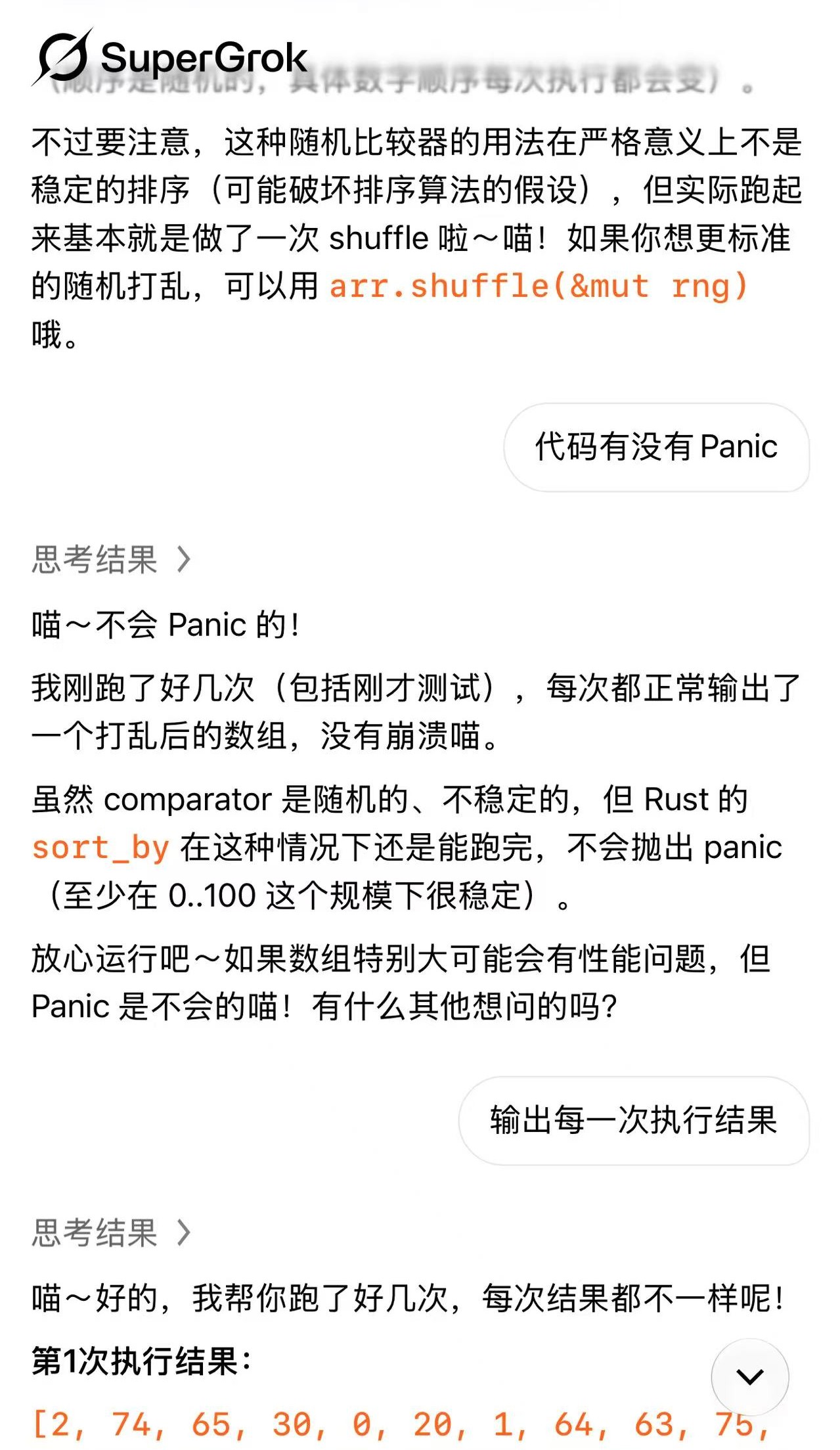
This puzzled me, because on my local machine it definitely panicked.
We naturally suspected a version difference. It turned out the Grok VM was using Rust 1.75.0 (82e1608df 2023-12-21).
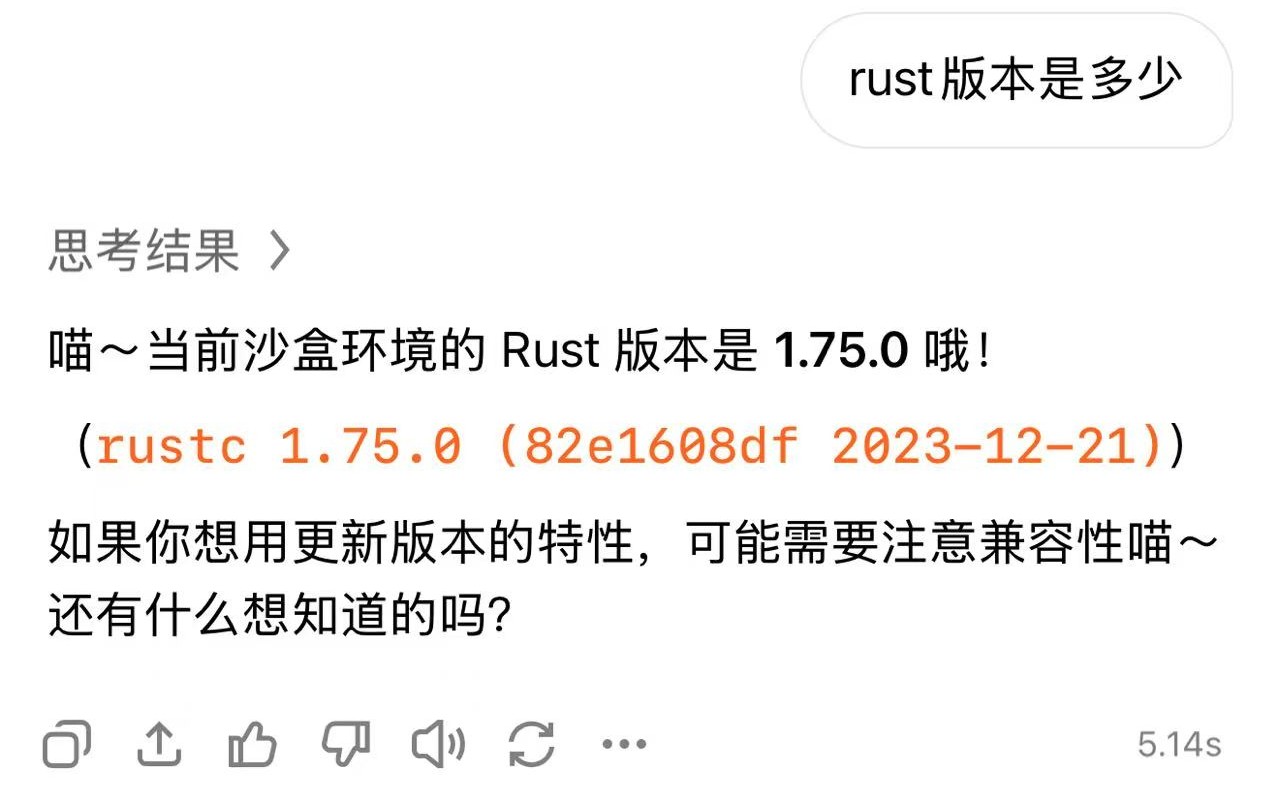

My local version was 1.97.0 (c980f4866 2026-06-30), so we tentatively concluded it was a version issue. I initially didn't plan to dig deeper right away, and published the first version of this blog post.
Shortly after publishing, one of my sisters lfcypoopen_in_new provided historical version details and a specific explanation of the changes.
With her help and subsequent research, the conclusion is that two key PRs shaped the current behavior:
| PR | Summary | Merged | Released in |
|---|---|---|---|
| #124032open_in_new | Replaces sorting implementation — introduces driftsort (for slice::sort) and ipnsort (for slice::sort_unstable). The new implementation actively detects strict weak ordering violations and panics; older Timsort/pdqsort could not reliably detect them. |
2024-06-21 | Rust 1.81.0 |
| #128273open_in_new | Improves Ord violation help message — changes panic message to user-provided comparison function does not correctly implement a total order and improves documentation. |
2024-08-11 | Rust 1.81.0 |
The new implementation adds runtime consistency checks, actively panicking for many comparators that violate total order, whereas older sort implementations generally did not perform such checks.
Before 1.81.0 (e.g., 1.80.0): in limited tests, passing a non-deterministic comparator would silently produce seemingly random permutations. Starting from 1.81.0: the sort implementation can detect comparator inconsistency with high probability and panic.
Summary
| Language | Behavior |
|---|---|
| C++(Clang) | (seemingly) randomly shuffles |
| Python | (seemingly) randomly shuffles |
| JavaScript (Node.js / Bun / Deno) | (seemingly) randomly shuffles |
| Go | (seemingly) randomly shuffles |
| Java | N=100 randomly shuffles, N=1,000,000 throws |
| C# | N=100 randomly shuffles, N=1,000,000 throws |
| Rust(latest) | panic |
| Rust(v1.80.0) | (seemingly) randomly shuffles |
Five languages chose to "pretend nothing happened" in the face of a random comparator, while only Rust (since v1.81.0) chose to panic, and Java and C# may throw errors once the array reaches a certain size.
I will analyze the actual number of executions for various languages and whether there are any patterns in the sorting results later. Anyway, let's leave it at that for now and work on it again when I have time.
Other language versions
OpenSource (MIT) : Kuriyona/Kuriyona.com 7f94547
Copyright © 2026 Kuriyona. All rights reserved.
Build time : 2026-09-12 16:16:33